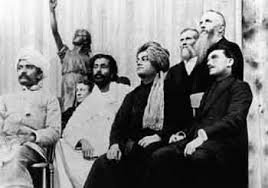
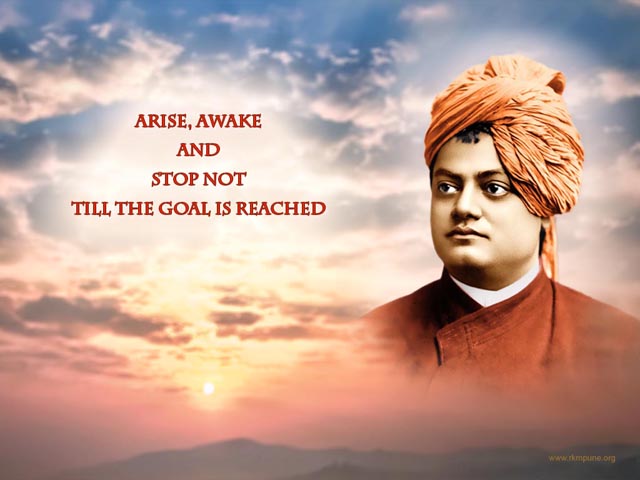
Vivekananda appeared to me immediately to be a man who was intensely moved by the sufferings of Humanity, and particularly of Humanity in India. Some of his tirades against middle class and upper class societies in this matter moved us to the depths of our being. He discovered for us the greatness of Man, and particularly of men in the humbler walks of life who were the despised and the denied in our Indian society. At the same time, he brought home to us the value of Indian thought at its highest and pristine best, as in the Vedanta. He was able to convince us that what our ancestors had left in the Vedanta Philosophy was of permanent value, not only for us in India but also for the rest of Humanity. This put heart in us, and made us feel a new kind of elation as members of a people who have always had a mission and a sacred task to serve Humanity. The Hindus as a race were losing their nerve, and it was Vivekananda who helped us to regain this nerve which we were losing. There was a lot of unthinking and unsympathetic criticism of our ways and our life, particularly from among Christian missionaries of the older type, and this was demolished by Vivekananda. All this made us hold him very close to our heart, and to think of him as a great master and as a new kind of incarnation who came down to earth to lead us into the good life and the life of the strong man. Vivekananda, in the first instance, knocked off a lot of nonsense in our Hindu social life, and drew our attention to the Eternal Verities and not to the ephemeral accidentals-social usages and such like-in our life. He was a sworn enemy of what we now call in India Casteism. Untouchability was something which he abhorred both as a sannyàsin and as a lay Hindu. He coined the word which is very commonly used in our Indian English-‘don’t touchism’. His heart overflowed with love and sympathy for the masses, whom he wanted to serve with religious zeal-serve as a believer in the Vedanta which sees God in all life. He coined a new word for our Indian languages-daridra-Nàràyaõa or a ‘God in the poor and the lowly’. This word has been accepted by the whole of India, and in a way it brings in a sense of responsibility for the average man. He has to look upon the poor and the humble, the suffering ones and the frustrated ones of society, as if they were deities incarnate or fragments of God, to serve whom was to serve God. Mahatma Gandhi’s revival of the old expression which was used in Gujarati by the Vaiùõava poets of Gujarat, namely, Harijana or ‘the Men of God’ was a very fine expression ; but daridra-Nàràyaõa implied or brought in an element of a sense of duty which was enjoined upon man to serve the poor if they wanted to serve God. Swami Vivekananda is looked upon as a great religious teacher, and indeed he made a definite contribution to the study of both Hindu religion and philosophy, and also in spreading a knowledge and appreciation of this philosophy and religion. His great works on aspects of Vedanta in theory and practice still inspire hundreds and thousands of enquirers all over the world. But it has also been said that he was more a philanthropist, one who dedicated himself to the service of man, than a religious theorist or preacher. One need not seek to analyse Vivekananda’s personality in this way. It is best to take the service of man as a form of serving God, for, from the point of view of all practical religion, God and Man are the obverse and reverse of the same medal. Vivekananda may be said to have been an innovator in two matters. As his great disciple Sister Nivedita suggested-he was the first to formulate the basic character of Hinduism as a system of thought and as a way of life in the modern age. This is the first great thing we as Indians may note about Vivekananda. Secondly, Vivekananda may be said to have brought before the Western World a new point of view in religious thinking-a new approach to the problems of faith- which they needed very badly. To this also might be added as a pendant that Vivekananda, as one of the thought-leaders of modern India, gave the tone to modern Indian culture. He conceived of an integration of all human religion and culture into one entity claiming the homage of all and sundry. I consider, and many agree with me also, that Swami Vivekananda’s participation and his magisterial and at the same time sweet and reasonable pronouncements at the International Congress of Religions at Chicago in 1893 form a very important event in the intellectual history of modern man.